
Within Ted Hughes' work, "Birthday Letters," I enjoyed the fact that they were written either for or around the relationship he had with Sylvia Plath. This viewpoint really helped me to connect more with their relationship, since a lot of the time neither of these poets really liked to come out and say "Hey! This poem is about Ted!" or "I wrote this about Sylvia!" Up until this point, the messages behind their poems were more muddled and I had to really dig through the pieces in order to figure out what lines were talking about who--or if a poem even had a relational reference in the first place.
 One piece that I really enjoyed reading was "Your Paris." It's an interesting view, even from the beginning. "Your Paris, I thought, was American" (line 1). Since Plath was from America and Hughes from Britain, Plath's view of Paris was utterly American--meaning that we stereotypically will see the word "Paris" and automatically think of romance, beauty, and perfection. We don't think about all of the pollution, or wars fought there, or anything like that. We choose, instead, to think of the stereotypical, romantic idea of Paris.
I kept my Paris from you...
The Capital
Of the Occupation and old nightmare.
I read each bullet scar in the Quai stonework
With an eerie familiar feeling (lines 9-13).

Within this poem, Hughes tries to explain that although Plath sees Paris as this beautiful, unadulterated city of dreams and romance, that it's so much more than that. It has a history of bloodshed and war, of revolutions and, like in any city, it has an underbelly of unrest. He even explains, "I was not much ravished by the view of the roofs" (line 28). This shows that his view of the city is much darker, and in his eyes, much more realistic--a roof is just a roof, no matter what city you are in.
To protect you from spontaneous combustion
Protected you
And your Paris. It scorched up
Every scent and sensor. And it seal
The underground (lines 45-50).
But one of the greatest things about this poem is that even though Hughes doesn't feel the same way about Paris as she does, Hughes continues to shield Plath from this underbelly of the city. He doesn't want to ruin her idealistic view of the city, even though he doesn't feel the same.
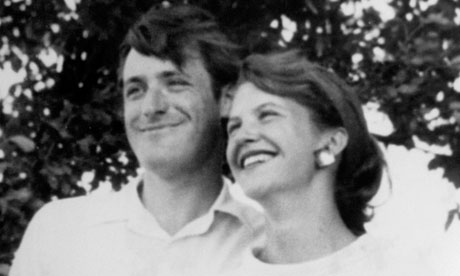 This, I feel, must have been the true love in their relationship--that he was willing to shield her from the ugly reality of humanity in order to allow her to continue seeing the good in the world, if only even for a moment. Perhaps this poem actually shows that Hughes knew about Plath's darker and more depressed side. Therefore, when he saw an opportunity to keep her in the light, he decided to grab hold of it with both hands and hold on for dear life.
In some ways your conclusion about the "true love" in their relationship is ironic even painful:
ReplyDelete"This, I feel, must have been the true love in their relationship--that he was willing to shield her from the ugly reality of humanity in order to allow her to continue seeing the good in the world, if only even for a moment."
I wonder to what extent it's this dynamic--Hughes trying to shield Plath--that set them up for many difficulties. What would have happened if he had told Plath, really told her, what Paris meant to him? Here his role reminds of that played by her mother early on, who involved her children in a fairyland and found it difficult to relate to Plath in her depression.
I really like the comparison you're making in between how Hughes shields her from the horrors of the Paris he sees and how her mother seemed to really shield her from the horrors of the world by engulfing her senses in a childhood fairyland. It's really interesting to think about the fact that no matter how much people in Plath's life tried to shield her from all the darkness--she still ended up fully engulfed in that darkness.
ReplyDeleteIt's really reminiscent of how people say the more you tell someone not to do something, the more they'll want to do it. It's almost like Plath pushed back against those shielding her by embracing what they wanted to keep her from seeing in the world.